
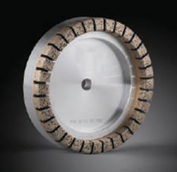
A full segmented diamond wheel is a professional grinding tool designed mainly for fast and controlled glass edge processing. It combines industrial diamond abrasives with a durable metal bond and a segmented working surface to remove glass efficiently while supporting cooling and debris removal.
In professional glass production, choosing the correct diamond wheel affects much more than grinding speed. Wheel diameter, diamond grit, bond quality, segment design, machine compatibility, cooling and production requirements can all influence edge quality, wheel life and the overall cost of processing glass.
This guide explains what a full segmented diamond wheel is, how it works, where it is used, its important specifications, how different qualities compare, typical pricing, leading brands and how to choose the right wheel for a glass edging machine.
What Is a Full Segmented Diamond Wheel?
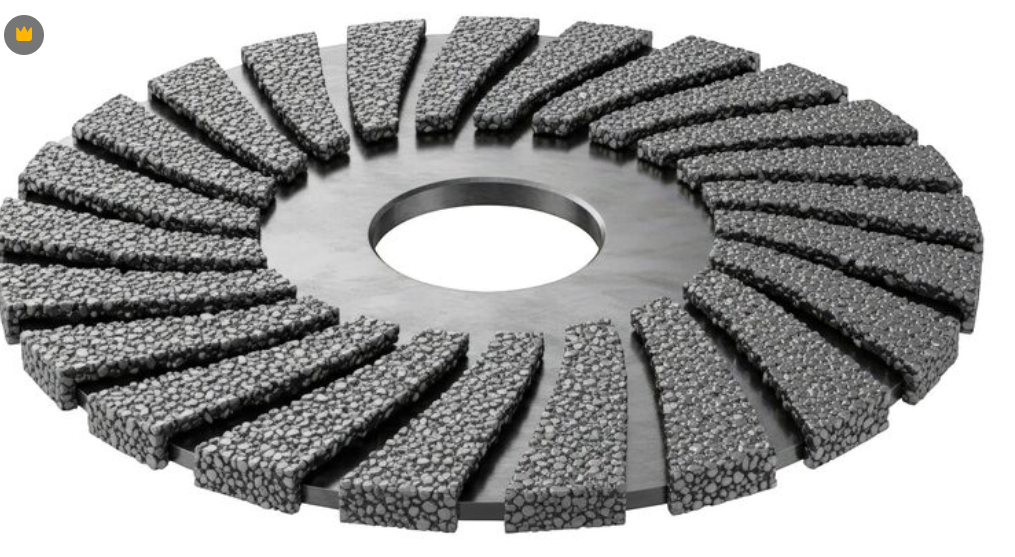
A full segmented diamond wheel is a type of metal-bond diamond grinding wheel commonly used during the rough grinding stage of glass edge processing.
The working surface of the wheel is divided into multiple diamond-containing segments rather than forming one completely continuous abrasive rim. These segments perform aggressive material removal while creating spaces through which coolant and grinding debris can move.
The wheel is generally produced using diamond abrasive particles combined with metal powders. Through a high-temperature and high-pressure manufacturing process, the materials form a strong abrasive working layer capable of handling demanding industrial grinding operations.
A full segmented diamond wheel is therefore normally used during the early stages of glass processing rather than as the final polishing wheel.
After the segmented wheel removes the required amount of material, finer diamond wheels, resin-bond wheels and polishing tools can progressively improve the glass edge.
Related topic: Metal Bond Diamond Grinding Wheels
How Does a Full Segmented Diamond Wheel Work?
When the wheel rotates against a glass edge, exposed diamond particles remove small amounts of glass from the surface.
The metal bond holds the diamond abrasive in position while the segmented structure creates spaces between the cutting areas.
These spaces provide several practical advantages during grinding.
They allow coolant to reach the grinding zone more effectively, help remove fine glass particles and reduce the concentration of heat around the contact area.
The wheel therefore performs two important jobs simultaneously:
Material removal and grinding-zone management.
This is one reason segmented wheels are particularly suitable for rough grinding, where significantly more material may need to be removed than during finishing or polishing.
Full Segmented Diamond Wheel Specifications
There is no single specification suitable for every glass-processing machine.
The correct configuration depends on the machine model, glass thickness, desired removal rate, spindle design and production requirements.
Common industrial specifications include:
| Specification | Typical Range |
| Outer Diameter | 130 mm, 150 mm, 175 mm |
| Segment Width | Approx. 10–15 mm |
| Segment Height | Approx. 8–10 mm |
| Bore / Hole Size | 12 mm, 22 mm, 50 mm and machine-specific sizes |
| Common Grit | 80#, 100#, 120#, 140# |
| Additional Grit Options | 180#, 240# and other configurations |
| Bond Type | Metal Bond |
| Primary Function | Rough Glass Edge Grinding |
| Common Machines | Straight-Line Edger, Double Edger, CNC Glass Machines |
The wheel diameter alone should never determine the buying decision.
Two wheels may both have a diameter of 150 mm but perform completely differently because of differences in bore size, abrasive grit, diamond concentration, bond formulation or segment geometry.
Why Diameter Matters
The outer diameter must correspond with the machine design and spindle configuration.
An incorrectly sized wheel may not fit properly or may operate outside the intended grinding position.
Why Bore Size Matters
The centre bore determines how the wheel fits onto the spindle.
Machine compatibility should therefore always be checked before purchasing the wheel.
Why Grit Size Matters
Grit determines how aggressively the wheel removes material.
Coarser grits such as 80# and 100# are commonly associated with heavier initial material removal, while finer options can help produce a smoother transition before subsequent finishing stages.
What Is a Full Segmented Diamond Wheel Used For?
The primary application of a full segmented diamond wheel is rough glass edge grinding.
It can form part of the production process for several types of processed glass, including:
- Architectural glass
- Building glass
- Furniture glass
- Tempered glass
- Laminated glass
- Safety glass
- Flat glass panels
Products such as glass doors, windows, shower enclosures, tabletops, office partitions and furniture panels normally require their raw edges to be processed before the final product is completed.
A segmented diamond wheel typically performs the aggressive first grinding stage.
The edge can then pass through finer grinding and polishing stages until the required finish is achieved.
This makes full segmented wheels particularly important for production environments where both processing speed and predictable tool life influence manufacturing cost.
Why Use a Full Segmented Diamond Wheel?
The main reason for selecting a segmented diamond wheel is efficient material removal.
However, several related performance characteristics make this type of wheel valuable.
1. High Grinding Efficiency
The segmented diamond surface can remove glass aggressively, making it useful in early-stage processing.
2. Better Coolant Access
Spaces between the segments allow water or other approved coolant systems to reach the grinding contact area more effectively.
3. Heat Management
Better coolant access can help control grinding temperature during continuous operation.
4. Efficient Debris Removal
Grinding waste and fine glass particles can move away from the contact zone through the spaces between segments.
5. Long Tool Life
Metal-bond constructions are designed for demanding grinding applications and generally offer greater wear resistance than softer finishing or polishing bonds.
6. Production Consistency
A correctly selected wheel can provide predictable material removal across repeated production cycles.
What Makes a High-Quality Full Segmented Diamond Wheel?
Two wheels with identical dimensions are not necessarily equal in quality.
Several manufacturing and material factors influence actual grinding performance.
Diamond Quality
The characteristics of the diamond abrasive influence cutting ability and wear behaviour.
Diamond Concentration
The amount and distribution of abrasive within the working layer can affect both cutting performance and wheel life.
Bond Formulation
The metal bond must hold the diamond particles while wearing at an appropriate rate to expose new cutting points.
Segment Consistency
Uniform segment geometry contributes to stable grinding.
Wheel Balance
Poor balance may contribute to vibration and inconsistent edge processing.
Manufacturing Precision
Industrial wheels designed with tighter tolerances may provide more predictable performance in high-volume production environments.
This is why wheel quality should not be evaluated only by purchase price.
Professional users should also consider:
Grinding speed + edge quality + usable wheel life + downtime + cost per processed metre.
Grinding speed + edge quality + usable wheel life + downtime + cost per processed metre.
Full Segmented Diamond Wheel vs Continuous Diamond Wheel
These two wheel constructions should not automatically be viewed as competitors because they can perform different stages of glass processing.
| Feature | Full Segmented Wheel | Continuous Wheel |
| Working Surface | Multiple segments | Continuous abrasive rim |
| Main Priority | Aggressive removal | Controlled, finer grinding |
| Coolant Channels | More open segment gaps | More continuous contact |
| Material Removal | Generally higher | Generally more controlled |
| Typical Stage | Rough / early grinding | Finer grinding stages |
| Main Objective | Speed and removal | Surface control and finish |
A segmented wheel is generally preferred when heavy material removal and efficient coolant movement are priorities.
A continuous wheel may be more suitable when smoother and more controlled grinding is required.
In a professional glass edging line, both designs can therefore be used as part of the same overall processing sequence.
Internal link opportunity: Segmented vs Continuous Diamond Wheel
Full Segmented Diamond Wheel vs Resin Wheel
Another important semantic distinction is between a metal-bond segmented diamond wheel and a resin-bond wheel.
A full segmented wheel is primarily associated with aggressive material removal.
A resin wheel generally belongs to later processing stages where improving surface quality and preparing the edge for polishing becomes more important.
A simplified production sequence may look like:
Segmented Diamond Wheel → Finer Diamond Grinding → Resin Grinding → Polishing
Understanding this sequence prevents buyers from selecting a wheel simply because it fits the machine physically.
The wheel must also match the intended processing stage.
Which Machines Use Full Segmented Diamond Wheels?
Professional glass-processing equipment can include several grinding positions.
Full segmented and related diamond wheels are commonly associated with:
Straight-Line Edging Machines
Used to process straight glass edges through several progressive grinding and polishing stations.
Double-Edging Machines
Designed to process opposite glass edges efficiently in industrial production lines.
CNC Glass Processing Machines
Specialised diamond tooling can also be used in automated glass-processing systems depending on machine configuration.
Major glass-processing machinery manufacturers such as Bavelloni, Bottero and Schiatti Angelo produce equipment that incorporates professional diamond-wheel grinding positions.
However, compatibility must always be confirmed based on the specific machine model, spindle and tooling requirements.
What Causes a Diamond Wheel to Perform Poorly?
A wheel that produces unsatisfactory results is not automatically a poor-quality product.
Performance can also be affected by operating conditions.
Common factors include:
Incorrect Grit Selection
A grit that does not match the required removal stage may grind too slowly or produce an unsuitable surface.
Insufficient Coolant
Poor coolant delivery can increase heat and reduce effective debris removal.
Incorrect Feed Speed
Production speed must match the wheel, machine and removal requirements.
Excessive Grinding Pressure
Using excessive pressure can negatively affect both the wheel and the processed edge.
Machine Vibration
Spindle condition, wheel balance and machine setup can influence grinding stability.
Incorrect Wheel Specification
Using the wrong diameter, bore, width or wheel type can cause poor results even if the wheel itself is high quality.
Internal link opportunity: Common Glass Grinding Problems and Solutions
How Can You Increase Full Segmented Diamond Wheel Life?
Longer tool life begins with correct wheel selection.
Choose the appropriate diameter, bore size, grit and bond for the machine and glass-processing requirement.
Coolant delivery should also remain consistent during operation.
The wheel should not be forced to remove more material than its intended configuration allows.
Machine condition matters as well. A wheel operating on a poorly maintained spindle may produce inconsistent results regardless of its manufacturing quality.
Professional manufacturers should therefore monitor performance using measurable production data.
One useful metric is:
Processed glass metres per wheel
rather than simply:
Operating hours per wheel.
This provides a better indication of actual production value.
Full Segmented Diamond Wheel Price
There is no universal price for a full segmented diamond wheel.
Pricing varies according to:
- Diameter
- Bore size
- Segment dimensions
- Diamond concentration
- Abrasive quality
- Bond formulation
- Grit
- Manufacturer
- Country of origin
- Customisation
- Order quantity
- Machine compatibility
Current examples from the commercial market show substantial price differences between standard and premium tooling.
The source article records examples of standard commercial wheels around ₹5,500 to ₹9,000 per piece, depending on supplier and specification. Premium European segmented glass grinding tools can be significantly more expensive, with some specialist configurations listed in the range of approximately £157 to £388 excluding VAT. These figures should be treated as examples rather than fixed worldwide prices.
Standard vs Premium Full Segmented Diamond Wheel
Price should not be viewed independently from production performance.
| Factor | Standard Wheel | Premium Wheel |
| Purchase Cost | Lower | Higher |
| Manufacturing Tolerance | Varies | Usually tighter |
| Production Consistency | Supplier dependent | Often more predictable |
| High-Volume Suitability | Depends on application | Often designed for intensive use |
| Wheel Life | Variable | Potentially longer |
| Technical Support | Varies | Often stronger |
| Cost per Metre | Must be calculated | Must be calculated |
A cheaper wheel may be economical when production requirements are moderate.
However, a premium wheel may offer better commercial value in a high-volume factory if it reduces downtime, increases feed speed or lasts substantially longer.
Why Cost Per Metre Matters More Than Wheel Price
Consider a simple example.
Wheel A
Purchase price: $80
Usable production: 5,000 metres
Cost per metre:
$0.016
Wheel B
Purchase price: $150
Usable production: 15,000 metres
Cost per metre:
$0.010
Although Wheel B costs almost twice as much initially, its cost per processed metre is lower in this example.
This is why professional buyers should avoid judging industrial tooling only by the invoice price.
The more important calculation is:
Wheel Cost ÷ Total Processed Metres = Tool Cost Per Metre
Production downtime and rejected glass can also be considered when calculating the true operating cost.
Which Companies Provide Full Segmented Diamond Wheels?
The existing market includes both premium European tooling companies and more economical specialist manufacturers.
Diamut
Diamut is positioned within the premium professional glass-processing tooling market and develops advanced grinding technologies for industrial applications.
Mole Moreschi
Mole Moreschi provides specialist diamond grinding products, including high-speed segmented tooling for professional glass processing.
Jincheng
Jincheng provides industrial segmented diamond wheels in commonly used dimensions and grit configurations.
Aimgrind
Aimgrind supplies full segmented wheels for glass edging with different diameters and grit options.
There is no single brand that can automatically be considered the best for every application.
The best manufacturer depends on:
Machine + glass type + required removal + production volume + budget + desired wheel life.
How to Choose the Best Full Segmented Diamond Wheel
Before buying a wheel, follow this selection process.
Step 1: Check the Machine
Confirm the manufacturer, model, spindle and wheel position.
Step 2: Confirm Diameter
Use a wheel diameter compatible with the machine specification.
Step 3: Confirm Bore Size
The centre hole must match the machine spindle or approved mounting system.
Step 4: Determine Grinding Stage
Identify whether the wheel will perform initial rough grinding or a later finishing stage.
Step 5: Select the Correct Grit
Choose grit according to the required material removal and desired transition to the next wheel.
Step 6: Consider Glass Type and Thickness
Production conditions can differ depending on the type and thickness of glass being processed.
Step 7: Evaluate Production Volume
A wheel suitable for occasional processing may not be the best option for continuous industrial production.
Step 8: Compare Wheel Life
Ask suppliers for realistic performance expectations where available.
Step 9: Calculate Cost Per Metre
Compare production value rather than only purchase price.
Is a Premium Full Segmented Diamond Wheel Worth It?
If production is low or moderate, a proven standard wheel might be appropriate. However, if the operation is a high volume manufacturing job, the cost of the tools compared to the significantly higher production time, machine downtime, edge defect and tool change costs. If a premium wheel offers the following, it may be worth the extra cost: • Longer usable life • More consistent grinding • Faster processing • Reduced downtime • Lower rejection rates Benefits of better cost per processed metre Prices are not necessarily higher quality.
Which wheel gives the best total production value for the specific glass-processing application?
Frequently Asked Questions About Full Segmented Diamond Wheels
What is a full segmented diamond wheel used for?
It is primarily used for rough grinding and material removal during professional glass edge processing.
Is a segmented diamond wheel used for polishing?
Its primary purpose is generally rough grinding rather than final polishing. Finer diamond, resin and polishing wheels are normally used in subsequent stages.
Which grit is commonly used?
Coarser grades such as 80# and 100# are commonly associated with initial aggressive grinding, although other grit options are available depending on the application.
What sizes are available?
Common industrial diameters include approximately 130 mm, 150 mm and 175 mm, with different widths and bore sizes depending on machine requirements.
Can the same diamond wheel fit every glass edging machine?
No. Diameter, bore, wheel width, spindle configuration and processing position must be compatible with the specific machine.
Why does a segmented diamond wheel need coolant?
Coolant helps control grinding temperature and remove glass particles from the contact area.
What is the difference between segmented and continuous diamond wheels?
Segmented wheels generally prioritise aggressive removal and coolant access, while continuous wheels offer uninterrupted abrasive contact that can suit finer grinding stages.
Are expensive diamond wheels always better?
Not necessarily. The better wheel is the one that delivers the required edge quality, production speed and usable life at an acceptable total processing cost.
How should diamond wheel value be compared?
For industrial production, cost per processed metre can provide a more useful comparison than purchase price alone.
Conclusion
Full segmented diamond wheel is an important tool in the industry for glass edge grinding. It is designed with metal-bond construction and a diamond abrasive and segmented working surface that is ideal for challenging initial removal of material. To determine the right wheel, you need to pick a wheel type as well as a diameter. Machine compatibility, bore size, grit, bond formulation, diamond quality, conditions in the coolant, glass thickness, production speed and expected wheel life should all be taken into consideration. The lowest cost wheel is not necessarily the most cost effective when compared to standard and premium products. It is more helpful to evaluate in terms of grinding efficiency, edge consistency, tool life, downtime and cost per metre processed. In the end, the best full segmented diamond wheel is the one that is appropriate to the machine, type of glass, grinding stage and desired production quantity and that provides consistent grinding performance at an operating cost compatible with the machine.